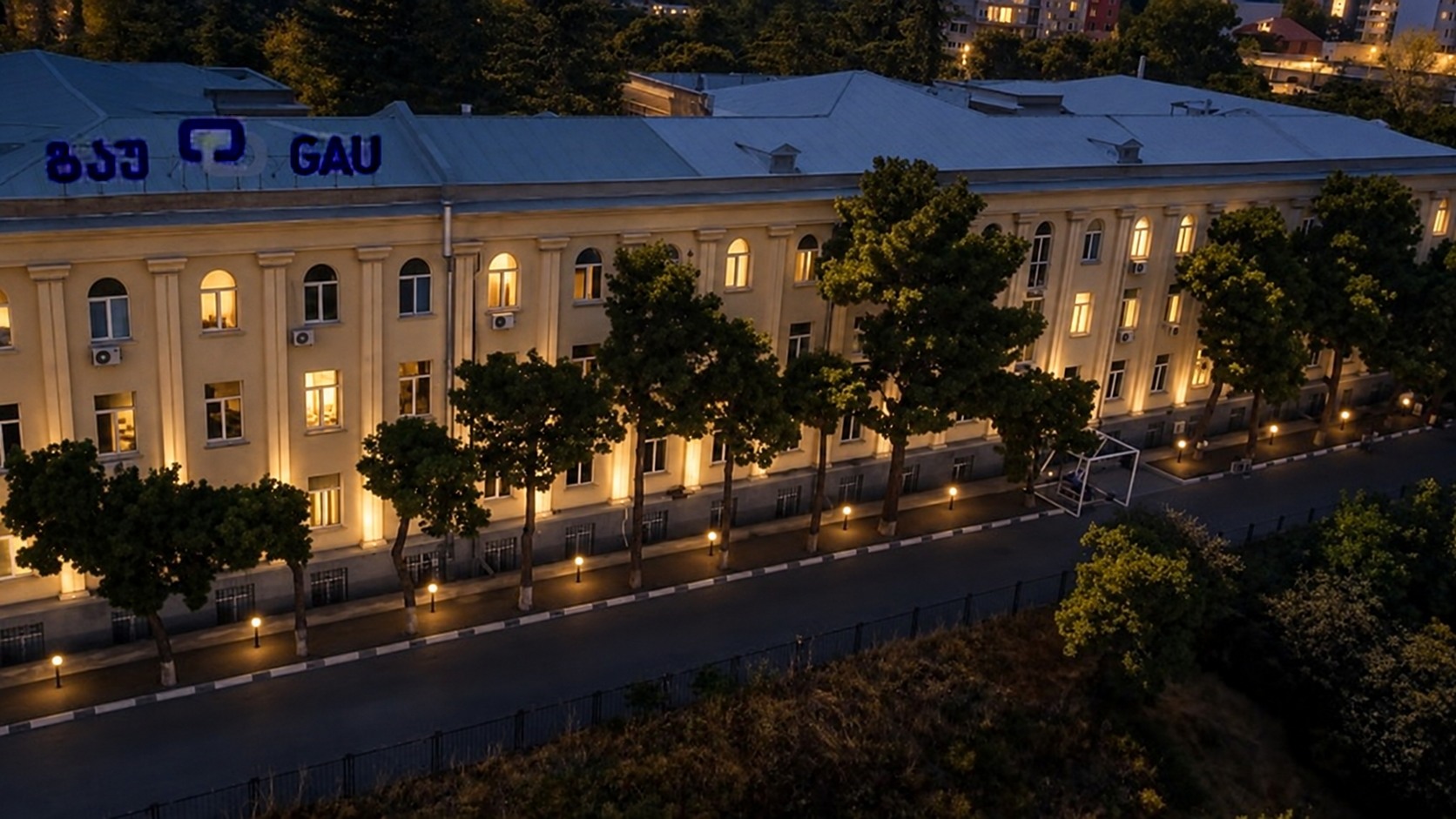
In Tbilisi, the Georgian American University offers an experience that goes beyond its name. Its identity is not solely medical, nor is it limited to business administration; it is an institution that brings together diverse schools of thought within a single urban environment, allowing students to see how administrative, technical, and health-related knowledge intersects. This is an attractive feature for those seeking a clear specialization, with the potential to explore fields that will influence their future career.
From Administrative Beginnings to a Multidisciplinary University
Founded in 2005, the university initially focused on business, but its academic structure has since expanded to include law, social sciences, diplomacy, information technology, engineering, humanities, and medicine. Located on Mirab Aleksidze Street in the Georgian capital, the university's location makes studying an integral part of city life, rather than an isolated experience on a distant campus. [1, 2]
This brief history gives practical meaning to its diversity: those studying technology need to understand institutions and users, those studying business benefit from digital thinking, and physicians work within systems that require communication, management, and data analysis. The existence of these schools does not automatically guarantee students courses in every field, but it does make interdisciplinary activities and projects an important consideration when choosing a program.
English Programs Beyond Medicine
The university's academic archive includes English-language programs in medicine, business administration, computer science, and information technology management, along with postgraduate administrative and technical studies. The list of international students remains the most accurate reference for identifying the program offered in a given semester; the presence of a specialization within a school does not necessarily mean it is available in every language or in every course. [1]
For a student interested in business, it is beneficial to read courses that focus on financial analysis, marketing, strategy, and decision-making. A computing student, on the other hand, benefits from examining the sequence between programming, algorithms, databases, and applied projects. This way, the comparison shifts from general terms to a clear understanding of what the student will learn and how they will apply it.
Medicine Through Integration and Application
The institutional archive describes the medical curriculum by linking basic and clinical sciences, using case studies, teaching problems, and structured practical assessments. The educational value of this approach lies in training students to connect information to clinical questions, rather than treating each subject as an isolated island. The actual training locations, the distribution of hours, and the language used with patients remain details tied to the approved plan for the cohort. [1]
Applicants can review a sample of the course units and ask how they transition from learning anatomy and physiology to collecting and interpreting clinical information. They will also benefit from learning about feedback and assessment methods; good medical education is not defined solely by content, but also by how skills are built and reviewed throughout the years.
Resources that Extend University Life
The official website features a library, a career center, research pages, student life and international relations sections, and GeoLAB. These resources are useful because they allow students to explore beyond the lecture schedule: Where can they find resources? How can they learn about activities? Who can help them understand career opportunities or exchange programs? [2]
Exchange announcements should not be interpreted as guaranteed travel for every student, but rather as competitive opportunities that require careful consideration of requirements, language, and funding. The proactive student can transform these resources into a personal plan: a communication-developing activity, a project that demonstrates a specialized skill, and regular reading beyond the minimum course requirements.
Tbilisi as part of the experience
The capital offers a diverse cultural context, encompassing its historic districts, modern streets, and artistic institutions. A museum visit or a stroll through the Old Town can be a culturally enriching break, with time and transportation options optimized for studying. Learning basic Georgian phrases is also helpful in everyday situations and enriches the connection to the place. [3]
GAU seems suitable for the student who prefers a multi-school urban university and wants to explore a specific English-language option in business, technology, or medicine. The practical step begins with matching the program, language, fees, and plan, and then checking for professional recognition when choosing a structured field. This article is an introduction to the institution and does not constitute an advertisement for admission or a direct partnership with UNIVEX.
Sources and references
- Source 1 · www.gau.edu.ge
Original source title
ملف UNIVEX المرجعي المؤسسي - Source 2 · www.gau.edu.ge
Original source title
الموقع الرسمي للجامعة - Source 3 · georgia.travel
Original source title
الهيئة الوطنية الجورجية للسياحة — تبليسي