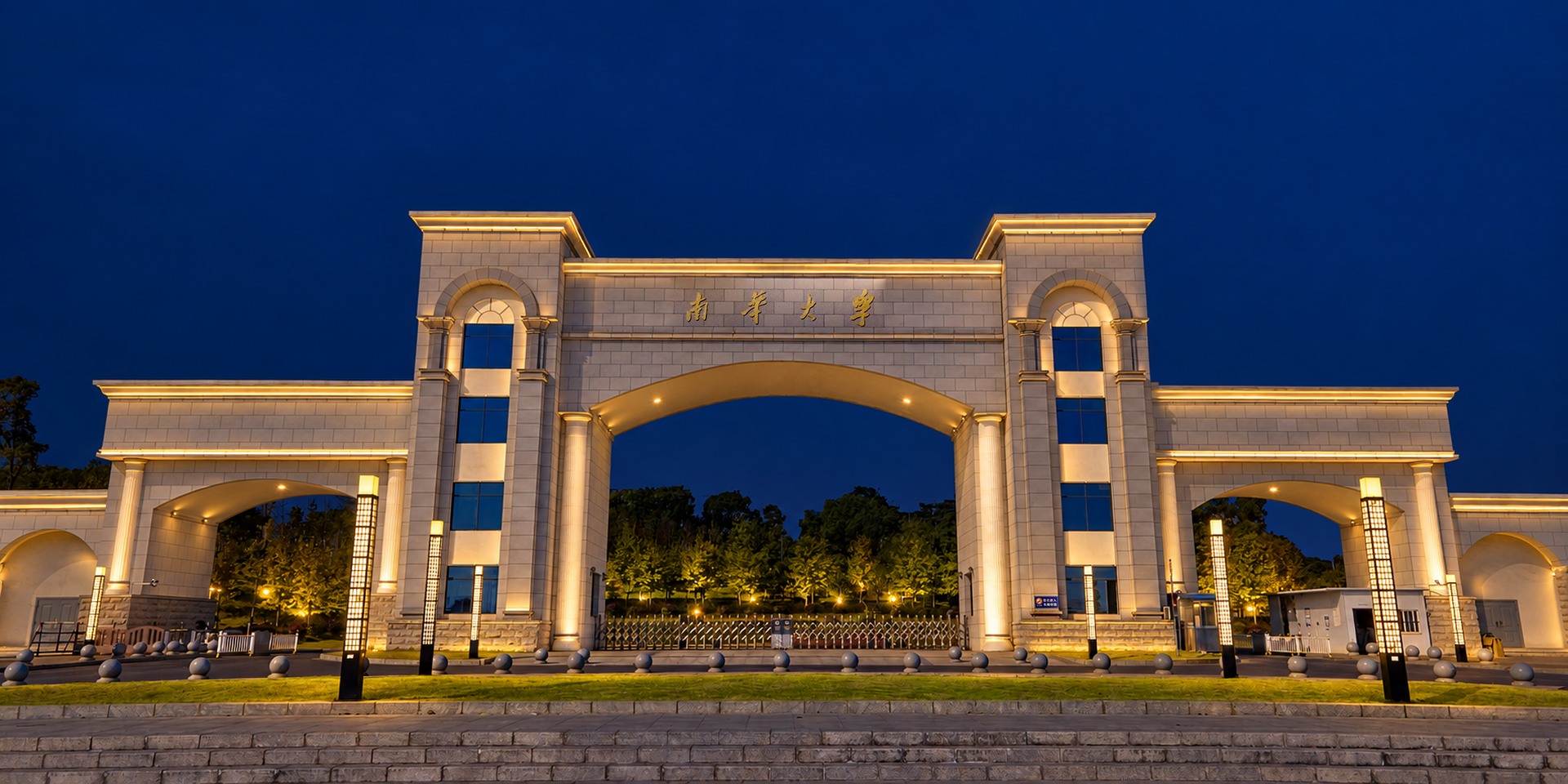
Not every university bearing the name "South China" is the same institution. The University of South China in Hengyang, Hunan Province, is a university that combines two distinct pillars: engineering and medicine, with a focus on the environment and the applications of science. This intersection helps define its character, distinguishing it from other universities in Guangzhou or elsewhere in China. [1]
Merger of Two Schools
The current university was founded in March 2000 through the merger of the Central South Institute of Technology and Hengyang Medical College. The medical component dates back to 1958, and the engineering component to 1959. The Sixth Research Institute of Nuclear Industry joined in 2002. [1]
This structure explains why technical and health-related fields are present in one institution. It doesn't mean that students study all of them, but rather that it provides a context where they can see how different expertise integrates around issues related to health, materials, resources, and the environment.
What Distinguishes Its Academic Landscape?
The university describes engineering and medicine as its two main pillars, alongside science, management, economics, law, and humanities. It refers to laboratories, experimental and simulation centers, and a network of affiliated hospitals in Hengyang and Changsha, as well as a library, digital resources, and scientific journals. [1]
This structure allows for a multi-faceted approach to understanding the university. Engineering students inquire about laboratories and projects, medical students about educational and training phases, and researchers about the group that best suits their subject. Comparisons are more accurate when each question relates to the specific program, rather than just a general institutional description.
When Health and the Environment Converge
Understanding the relationship between humans and their environment can enrich a student's experience. Health is influenced by environmental and regulatory factors, and engineering can provide tools for measurement and improvement. Students may learn to approach a single problem from a scientific, technical, and service-oriented perspective without overstepping the boundaries of their specialization.
For example, an educational question might concern data quality, a method for evaluating a process, or the impact of a design on usage. A project doesn't need a grand title to be useful; the important thing is to clearly define what it wants to measure, explain the methodology, and present the limitations of the outcome.
Resources for Reading and Participation
The portal offers pathways to the library, journals, activities, sports, and international student programs. [2] Students can integrate these resources into their daily routines: regular reading, group study, physical activity, and time for language development and academic presentation.
Maintaining a record of projects and acquired skills is also beneficial. This record should not be limited to certificates but should detail the problem the student worked on, their role, the tools used, and what they learned from the adaptation. This way, their progress becomes demonstrable when applying for internships or postgraduate studies, while acknowledging that the requirements for each opportunity are independent.
Hengyang and Program Location
The university is affiliated with Hengyang, while some of its health facilities are located in other cities. [1] Therefore, students must determine their study and internship location before arranging accommodation. This is not a minor administrative detail but a factor that impacts time, budget, and daily routines.
Practical Chinese phrases for navigating local life can be learned, and the language of instruction and training can be reviewed in the program guide. In health-related pathways, the professional practice requirements in the student's home country are examined independently of the university's name or the extent of its hospital network.
South China University deserves the attention of those seeking a multidisciplinary institution with a strong focus on engineering and medicine. Its most notable advantage lies in its integration of disciplines dealing with systems, people, and the environment, which translates into a specific course of study aligned with the student's goals.
Sources and references
- Source 1 · english.usc.edu.cn
Original source title
النبذة الرسمية والتاريخ والمرافق - Source 2 · english.usc.edu.cn
Original source title
برامج الطلاب الدوليين والحياة الجامعية