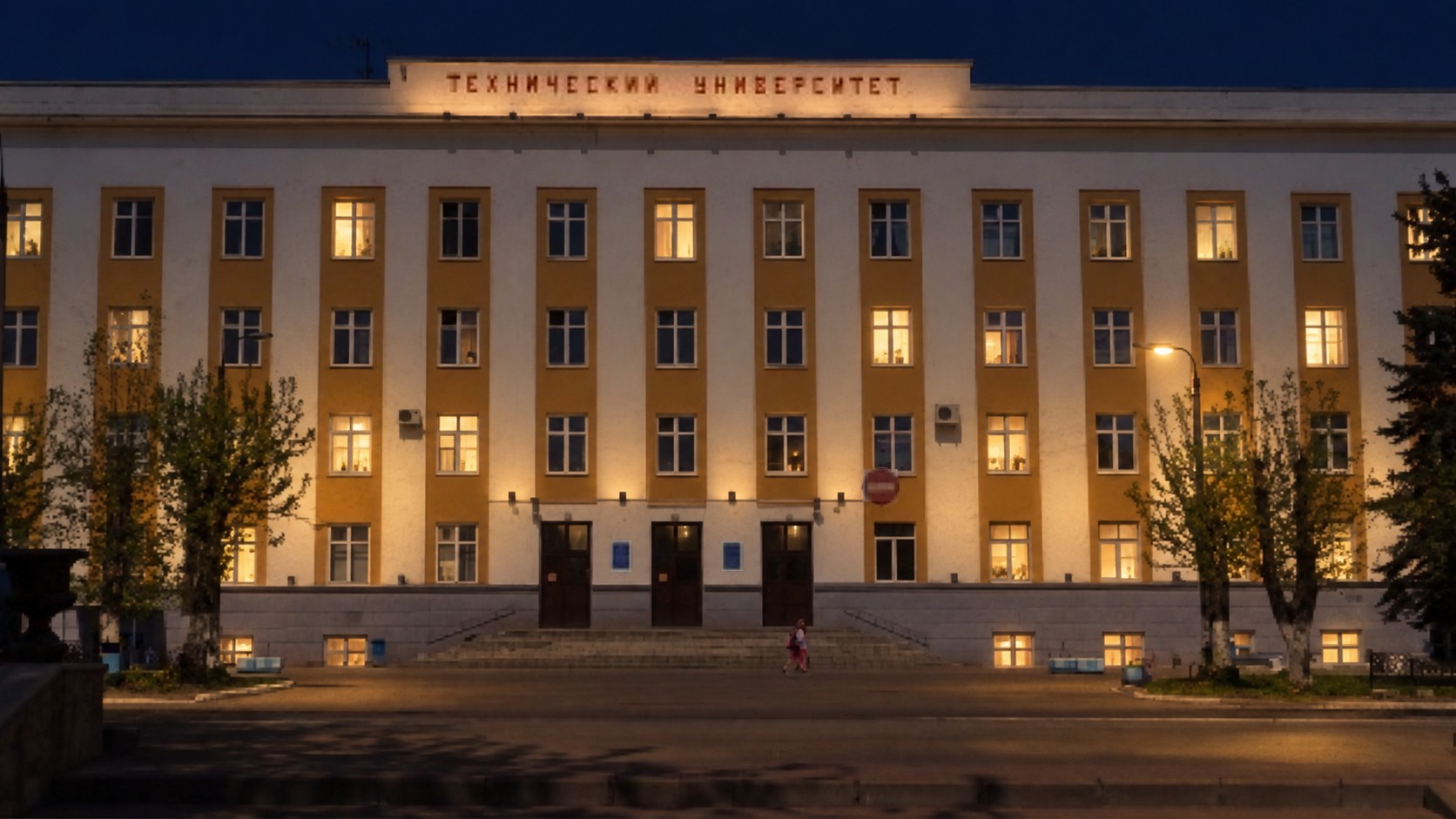

Behind Tver State Technical University lies a remarkable specialized origin: it is the institutional heir to the Moscow Peat Institute, founded in 1922. From this resource- and energy-related beginning, the university has expanded into the fields of construction, mechanics, and digital technologies. Understanding this origin allows students to grasp its character rather than simply viewing it as another technical institution. [1]
Resources Transformed into Engineering Questions
Located in Tver, the university's main campus is connected to the Afanasy Nikitin embankment, along with other buildings within the city. Its structure encompasses civil, mechanical, electrical, chemical, and computer sciences, as well as subjects in biotechnical devices and systems. [1]
This breadth explains how an institution with a natural resource origin can evolve as engineering needs change. Utilizing a resource requires machinery, energy, control, and measurement, and then the study of its environmental and economic impact. This connection allows students to see their specialization as part of a larger system.
Construction, Energy, and Transportation
Reference areas include civil engineering, construction, electrical engineering, mechanical engineering, and transportation. The list of programs open to international students and the language of instruction for each program are taken from the university's application process, as the academic inclusion of a field does not automatically guarantee admission. [1]
For example, a construction student might focus on design, materials, and site, while an energy student might be interested in networks, efficiency, and control, and a mechanical engineering student in system performance and manufacturing. These are practical distinctions that help in selecting courses and projects, rather than simply using the word "engineering" as a comprehensive description of the degree.
Digital Technology within the Engineering University
The profile includes computer science, information systems, software engineering, artificial intelligence, electronics, and instrumentation. The official portal offers academic and research news, learning resources, and student information. [1, 2]
In an engineering setting, computing takes on a practical meaning when it serves to model a system, analyze measurements, or monitor a process. A student with an aptitude for programming might inquire about the amount of mathematics, projects, and hardware involved in the program, as a term closely related to computing can lead to a different experience than theoretical computer science.
From Lecture to Model
Engineering skill is not complete with knowing the equation, but also includes choosing it, understanding its assumptions, and testing its results. Therefore, the program deserves to be viewed through the lens of projects and labs: What is the student designing? What data are they using? How are they documenting the technical decision?
A small project on energy consumption, a measurement sensor, or a structural model can be an opportunity to develop these habits. The important thing is that the presentation doesn't become a mere display of terminology; rather, the student should clarify the problem, the limitations of the solution, and what they learned from the experiment. This way of thinking remains useful after the course ends.
Language and Starting Plan
The educational environment is based in Russian, and the archives indicate experience in preparing international students linguistically. However, a current list of complete engineering degrees in English is not included in the reference materials used, and therefore, English is not offered as the common language for all programs. [1]
A preparatory year, when available and suitable for the program, can combine language and scientific preparation. The student needs to know its content and the requirements for progression afterward, not just its duration. Understanding terminology in mathematics and physics helps with keeping up with the curriculum, just as everyday conversation helps with integration.
City and Multiple Buildings
Sources indicate student housing, while educational buildings are spread across multiple locations in Tveier. Therefore, housing is planned according to the institute and the actual schedule, with confirmation of room allocation and its requirements. [1]
Tveier Technical Institute is worth considering for those interested in engineering applications related to resources, energy, and systems. The choice becomes more informed when the student specifies a particular area and checks the language, labs, training, and professional qualifications. In this way, industrial history becomes a context for understanding the study, not just an opening line.
Sources and references
- Source 1 · tstu.tver.ru
Original source title
ملف UNIVEX المرجعي المؤسسي - Source 2 · tstu.tver.ru
Original source title
الموقع الرسمي للجامعة